Someone says to you, calmly and carefully: "When you come home late and I don't know why, I feel worried, because I need some predictability. Would you be willing to send me a message?" And you think: I know this script. Is this person connecting with me, or steering me?
It is a fair question. Nonviolent Communication (NVC) is sometimes experienced as manipulative, and it is also often promoted with more confidence than the evidence supports. Let us look at both honestly.
What is NVC, in a few words?
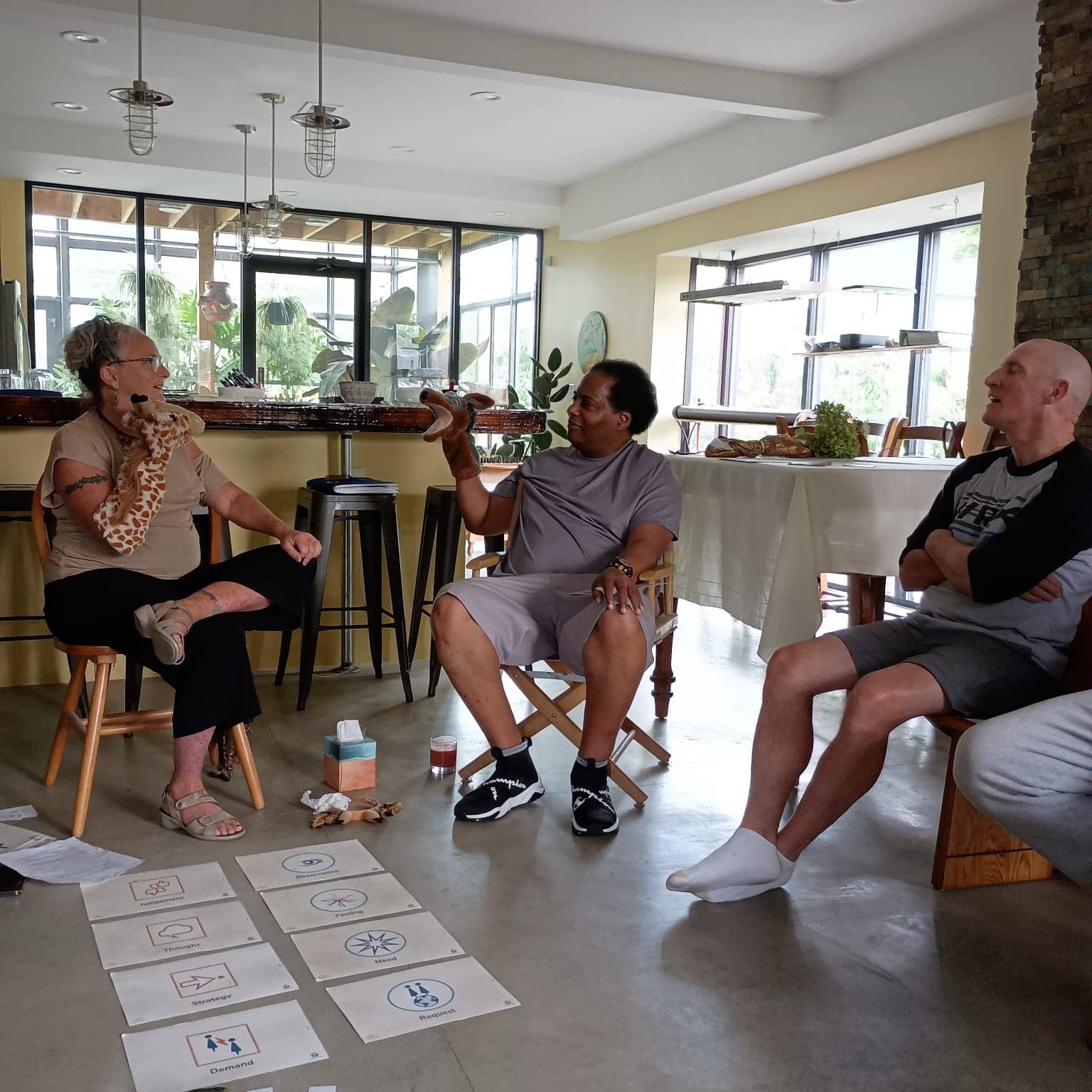
NVC was developed by Marshall Rosenberg (1934 to 2015), who began working on it in the 1960s. It is a way of speaking and listening built around four components: what we observe without judging, what we feel, what we need, and what we would like to ask for. Alongside that, it offers three forms of empathy: for yourself, for others, and for honest expression. You can read the longer story on our page about what NVC is, and in the article on the four steps.
Notice that the goal is connection, not a result. NVC is not designed to make someone do what you want. It is designed to help two people understand what matters to each of them.
Is NVC manipulative?
It can be used in a manipulative way, yes. Any communication skill can. If you say "I feel hurt that you don't care about me" with the intention of making someone feel guilty, you are using the form of NVC to apply pressure. The sentence is correct. The intention is not.
This is the difference between NVC as a technique and NVC as an intention. The technique is a set of phrases. The intention is genuine interest in your own needs and the other person's needs. The phrases without the intention can sound stiff, rehearsed, or cold. People notice, often right away. A common criticism is exactly that: the language sounds unnatural, or it gets used as a polite way to win.
Picture a manager who says to a team member: "I observe that you were late three times, I feel concerned, I need reliability, would you be willing to be on time?" It sounds correct. But if the manager has already decided the outcome and the team member knows it, the "request" is an order in disguise. A real request leaves room for a no, and the manager is actually interested in what the answer is.
How can you tell that it is being used manipulatively?
There are some signs, and they apply to you as much as to others.
- The request is not really a request. If a no is met with pressure, sulking or more explanation, it was a demand.
- The feeling is a judgment in disguise. "I feel manipulated" or "I feel ignored" describe what you think the other person did. Our article on feelings and thoughts explains this.
- Only one person gets empathy. If listening goes in one direction only, it is not connection.
- The language is a shield. Using a formula to avoid saying something plainly, or to avoid being close, is a sign that the form has replaced the contact.
If you recognise some of this in yourself, that is not a disaster. Most of us who learn NVC go through a stiff phase. The honest response is to slow down, and sometimes to drop the formula altogether and simply say something true in your own words.
Does NVC work at work? What does the research say?
This is where some caution is needed. In 2024, a scoping review in BMC Health Services Research looked at what has been published on NVC in healthcare work. It found seven studies with a total of 185 participants from six countries. The authors reported benefits such as better communication and teamwork, less conflict and aggressive behaviour, and a better working climate.
That sounds promising, and it is. But there are limits. The review is about healthcare settings only. It covers a small number of studies, and their quality varied: four were rated high, two moderate and one low. The authors themselves call for larger and more rigorous studies. So we can say that early research points in a good direction. We cannot say that NVC has been proven to work in every workplace, or for every person.
We have deliberately not quoted other figures here, because we could not check them. If you meet a very confident number in an advertisement for an NVC training, including ours, it is fair to ask where it comes from.
What does NVC at work actually do, and what does it not?
Think of a team where two people no longer talk to each other. A meeting is planned. One of them, instead of saying "you always undermine me", says what happened in the last meeting, how it felt, and what she needs to work well. The other one, instead of defending, tries to say back what he heard. Nothing is solved yet, but the room is quieter. That is what NVC can do: lower the temperature, and make it more possible to hear each other.
What it does not do is fix a workplace that is unfair. It cannot replace clear roles, fair pay, or proper protection against bullying. When there is a large power difference, asking the person with less power to be open and vulnerable may even make things worse. You can read more about this in the article on NVC in conflict and mediation. NVC also asks a lot of listening ability, and listening is what the next articles are about: empathy and self empathy.
What does a CNVC certified trainer mean?
The Center for Nonviolent Communication (CNVC) was founded in 1984. It runs a certification process for trainers. According to CNVC, candidates need at least 20 days of training with certified trainers to start, and 50 days in total, over a path that typically takes three to five years. Certification is not required to share NVC. It is one way to show a certain level of training and commitment.
Cordelia is a CNVC certified trainer. Her Level 1, 2 and 3 courses are her own levels, and are not CNVC levels. That is a useful thing to know when you compare trainings: ask what a level or title actually refers to.
Where can you try it and decide for yourself?
You do not have to believe anything. NVC is a practice, and the best test is your own experience: does it make a difficult conversation a bit easier, a bit more honest? Does the other person seem to relax, or to feel pushed?
If you are curious, the free two hour intro workshop is a gentle place to start, with no commitment. Our Level 1 Foundation goes deeper, at a calm pace. And you are always welcome to ask questions, including critical ones.
Sources: Adriani and colleagues, Non violent communication as a technology in interpersonal relationships in health work: a scoping review, BMC Health Services Research, 2024. CNVC, certification program outline.
Frequently asked questions
Is nonviolent communication manipulative?
It can be, if the phrases are used to make someone feel guilty or to win. NVC is meant as an intention to connect, with a real request that allows a no. Used as a formula to pressure people, it feels manipulative, and people usually notice.
Does NVC work at work?
Early research suggests benefits such as better communication and less conflict. A 2024 scoping review found 7 studies with 185 participants, all in healthcare, of mixed quality. The authors ask for larger and stronger studies, so the evidence is promising but limited.
What is the main criticism of NVC?
Common criticisms are that fixed phrases sound unnatural or insincere, that it can be used to get your way politely, and that it cannot solve power differences or unsafe situations on its own.
Do you need to be CNVC certified to teach NVC?
No. According to CNVC, certification is not required to share NVC. Certification is a separate path of at least 20 training days to start and 50 in total, usually over three to five years.
.jpeg)