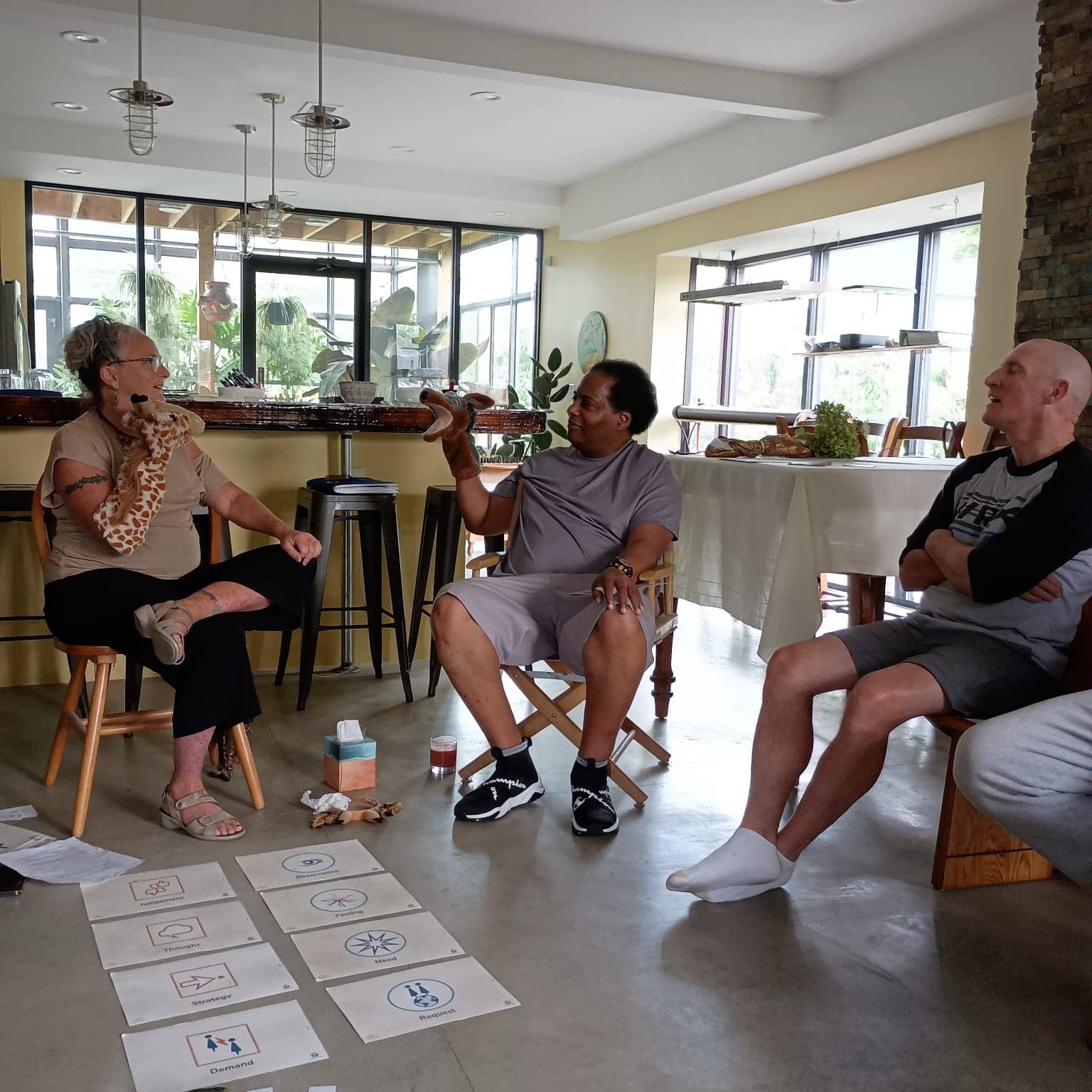
You walk into the kitchen and the dishes are still in the sink. Before you have taken a breath, a sentence appears in your mind: "You never help." It feels like a plain fact. In Nonviolent Communication (NVC), we would call it an evaluation, and learning to tell it apart from what we actually see opens up a different kind of conversation.
What is an observation in NVC?
An observation is what you could see or hear, described without adding meaning. It is the first of the four steps of NVC, and it gives the other person something easy to agree with.
"There are three plates and two pans in the sink" is an observation. "You never help" is an evaluation, because it holds a conclusion about the person and about every day of the past. Observations keep us in the shared present, which is a helpful place to start.
What is the difference between an observation and an evaluation?
An observation is specific and can be checked. An evaluation is an opinion, a label or a generalization, and it often arrives with words like always, never, lazy, rude or selfish.
Think of "you are always late" compared with "you arrived today at nine o'clock, and we had agreed on half past eight". The second sentence names a day, a time and an agreement. The first sentence contains a whole picture of who someone is. Most of us speak in evaluations, simply because that is the language we grew up with. NVC offers another way of speaking, one step at a time.
How can the camera test help you?
Ask yourself: could a camera have recorded this? A camera captures a person walking through a door at nine o'clock. It cannot capture "late", "inconsiderate" or "disrespectful", because those are meanings we add ourselves.
The camera test is a friendly little tool you can use any time. When a sentence passes, you have probably found an observation. When it does not, you have found an invitation to look a bit closer: what did I actually see or hear? Often a single concrete detail, a time, a number or a quote, is enough to turn the sentence around.
What are some everyday examples?
Here are a few, with the evaluation on the left and a possible observation on the right.
- "You never listen" becomes "While I was talking, you looked at your phone twice."
- "The meeting was a mess" becomes "The meeting ran thirty minutes over, and we did not get to the third item."
- "She is so lazy" becomes "I have seen the report on her desk since Tuesday."
- "You are always late" becomes "You arrived at nine o'clock today."
Notice how the second versions are quieter. They carry less charge, so the other person can hear them without needing to defend themselves. That opens space for the next steps: what I feel, what I need, and what I would like to ask.
Do we have to give up our opinions?
Not at all. Opinions and judgments are a natural part of being human, and they often point to something that matters to us. In NVC we simply hold them lightly and look for the need behind them. Behind "you never help", there may be a need for support or for shared care.
You can also pair an observation with your feelings. "When I see the dishes in the sink after a long day, I feel tired and a bit discouraged, because I would love some support at home." For more on that middle part, take a look at feelings vs thoughts in NVC. Starting with what you see gives your words a soft landing.
What is a short exercise for this week?
Choose one situation each day that bothered you a little. Write down the sentence you first thought, then rewrite it as a camera would describe it. Include a day, a time or a number where you can.
After a few days you may start to hear evaluations in everyday talk, in the news, and in your own head. You can smile at them, and gently translate. It is a skill that grows with practice, and every attempt counts.
If you would like to practice together, we do exactly this in the Level 1 Foundation course. You are also welcome to begin with the free two hour intro workshop, or have a look at Start here for a first overview.
Frequently asked questions
What is an observation in NVC?
An observation is what you can see or hear, described without added meaning, such as "you arrived at nine o'clock". It is the first of the four steps of NVC and gives the other person something easy to agree with.
What is the difference between observation and evaluation?
An observation is specific and can be checked. An evaluation is an opinion, label or generalization, often with words like always, never or lazy. "You are always late" is an evaluation, while "you arrived at nine o'clock" is an observation.
What is the camera test in NVC?
Ask yourself whether a camera could have recorded what you are describing. A camera can capture a person walking in at nine o'clock, but not "late" or "rude". If a camera could not record it, it is probably an evaluation.
Do I have to give up my opinions in NVC?
No. Opinions are a natural part of being human and often point to something that matters to you. In NVC we hold them lightly and look for the need behind them, then share an observation, feeling, need and request.
.jpeg)